Is Waiting for Godot a Play About Hope or is Hope Itself the Most Dangerous Form of Self-Deception?
Source: NotebookLM

Academic Details
Name: Kruti.B.Vyas
Roll No.: 12
Sem.: 2
Batch: 2025 - 2027
Assignment Details
Paper Name: The Twentieth Century Literature: From World War II to the End of the Century
Paper No.: Paper 107
Paper Code: 22400
Unit 1: Samuel Beckett's Waiting for Godot
Topic: Is Waiting for Godot a Play About Hope or is Hope Itself the Most Dangerous Form of Self-Deception?
Submitted To: Department of English, Maharaja Krishnakumarsinhji Bhavnagar University, Bhavnagar
The following information numbers are counted using QuillBot.
• Images: 3
• Words: 3628
• Characters: 25231
• Characters without spaces: 21700
• Paragraphs: 102
• Sentences: 197
• Reading time: 14 m 31 s
Table of Contents:
The Anatomy of Hope and Deception End of Table of ContentsTable of Contents
Front Matter & Research Framework
1. Existential Abyss & 2. Phenomenology
3. Rituals of Hope & 4. Psychological Void
5. Postmodern Rupture & 6. Emancipation
7. Theatricality & 8. Existential Defiance
Abstract
This exhaustive research report explores the central philosophical conundrum in Samuel Beckett’s Waiting for Godot: whether the play affirms hope or exposes it as the ultimate form of self-deception. By synthesizing contemporary scholarship on existentialist theory, postmodern fragmentation, the phenomenology of time, and psychoanalysis, the analysis evaluates the act of waiting as a fundamentally hollow ritual. It contrasts the destructive nature of teleological hope (waiting for an external savior) with the emergence of a secularized, minimalist resilience based on human solidarity. Ultimately, this report argues that while the expectation of Godot is a toxic illusion that perpetuates existential paralysis, the characters' shared endurance constitutes a redefined, fragmented hope suitable for a post-traumatic, meaningless universe.
Keywords
Existentialism, Absurdism, Hope, Self-Deception, Waiting for Godot, Postmodernism, Phenomenology, Divided Self, Temporal Stagnation, Secularized Hope.
Research Question
Does Samuel Beckett's Waiting for Godot articulate a resilient, underlying hope that sustains humanity through the abyss of an indifferent universe, or does it posit that teleological hope itself is the ultimate, most paralyzing form of self-deception? Furthermore, how do the mechanics of temporal stagnation and the psychological concept of the "divided self" systematically dismantle the play's traditional interpretations of hope?
Hypothesis
The rigorous application of existential, psychoanalytic, and postmodern critical frameworks reveals that the traditional hope for an external savior (Godot) in Waiting for Godot functions primarily as a debilitating psychological defense mechanism and a toxic form of self-deception. By interrogating the characters' cyclical waiting, it becomes evident that this teleological expectation actively perpetuates their existential paralysis and suffering. However, in aggressively dismantling this grand narrative, the play simultaneously cultivates a minimalist, highly self-aware resilience, a secularized hope rooted in the characters' stubborn co-dependency and active endurance in the void.
Research Gap
Historically, modernist and existentialist criticism of Waiting for Godot has frequently treated the concept of "hope" as a strict binary: either the characters are tragically hopeful, or the play is entirely nihilistic. There is a significant critical gap in synthesizing the psychological dimensions of hope as a ritualized "hobby" with Theodor W. Adorno’s postmodern concept of "secularized hope" (Adorno, 1966). This research bridges that gap by demonstrating how teleological self-deception and minimalist resilience coexist dialectically within the text, moving beyond simple nihilism to define a nuanced survival mechanism appropriate for modern society.
1. Introduction to the Existential Abyss
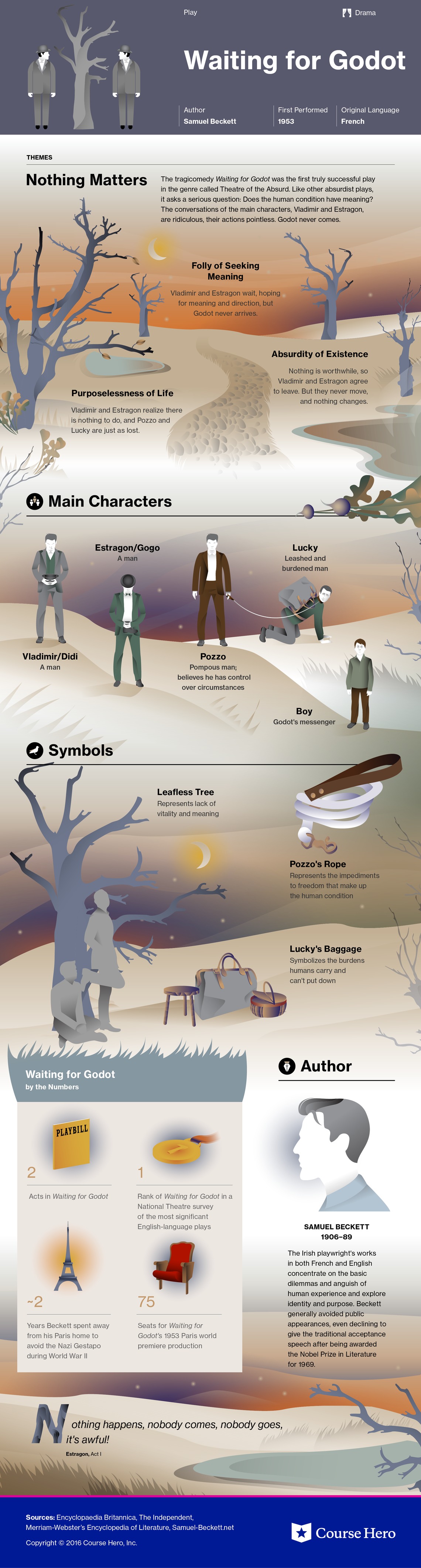
Since its 1953 premiere, Beckett’s Waiting for Godot has defined absurdist literature, focusing on Vladimir and Estragon's stalled, circular wait for a savior. Debate is split: does the vigil show resilience or self-deception? Critics arguing for existential despair see hope as a "toxic illusion," a psychological defense mechanism that blinds the characters to their stagnation and meaninglessness, making waiting a paralyzing entrapment.
Conversely, a modern view suggests Beckett replaces grand, "teleological" hope with a minimalist resilience. By dismantling old narratives, the play shifts focus to a secularized solidarity. This "hyper-aware resilience" posits that while waiting for an external Godot is delusion, the shared act of enduring the void is a defiant moral affirmation of human connection. Ultimately, true hope is not the expectation of rescue, but the intersubjective decision to survive the absurdity of the present together.
2. The Phenomenology of Waiting and the Suspension of Existence
To evaluate whether hope operates as a form of self-deception, it is imperative to first rigorously deconstruct the primary mechanism through which it manifests in the play: the act of waiting. Waiting is not merely a passive, transitional state for Vladimir and Estragon; it is the entirety of their ontological reality. As Priya observes, it is a condition of despair and detachment that reveals the profound cavities and neuroses of modern consciousness.
The Hollowness of Unbounded Expectation
Unlike normative waiting, which anticipates a justifying resolution, Beckett's waiting is "endless and unbounded," stripping the act of meaning and leading to "ultimate despair" and psychological "trauma" (Priya). The characters are trapped in a "temporal vacuum," a "metaphor for the suspension of existence," where growth and progress are structurally impossible (Priya). This stagnation is emphasized by the cyclical structure and repetitive actions. Their futile situation is reflected in "bombous dialogues" and "fragmented conversations," highlighting alienation and moral erosion (Priya). To occupy the void, they engage in trivial, repetitive actions like abortive departures, hat exchanges, and struggling with boots. These actions do not advance the narrative but underscore the characters' spatial and temporal imprisonment, reinforcing an atmosphere of "temporal stagnation" and "existential anxiety" (Priya).

Source:Napkin Ai
Existential Ennui and the Nullification of Linear Time
The characters' perpetual suspension leads to profound ennui and boredom. Lacking direction, they invent futile distractions from Estragon's tight boots and hunger to Vladimir's philosophical musings and unreliable memory which are mere inadequate bandages for their existential despair. This dynamic embodies the existentialist "problem of absurdity." The bleak, desolate setting mirrors this internal desolation, reinforcing the nihilistic premise that life lacks intrinsic meaning, perfectly summarized by Vladimir's "Nothing happens, nobody comes, nobody goes, it's awful." Their predicament manifests Martin Heidegger’s Geworfenheit ("thrownness"), where humans are dropped into an indifferent universe without a predefined purpose, burdened with creating meaning. Instead of self-creation, the characters paralyzingly wait, abdicating this existential responsibility.
Phenomenological Concept | Theatrical Manifestation in Waiting for Godot | Scholarly Interpretation and Philosophical Implication |
Temporal Stagnation | Circular, repetitive dialogue; inability to physically leave the stage; recurring days with no memory continuity between acts. | Represents an ahistorical prospect and the absolute nullification of linear historical time, trapping characters in a perpetual present. |
Existential Geworfenheit | A barren road, a single leafless tree, total absence of societal structures, institutions, or geographic markers. | Symbolizes humanity abruptly dropped into an indifferent world, forcing the agonizing self-creation of essence. |
Ennui & Distraction | Playing meaningless games, inspecting hats/boots, contemplating suicide as a mere pastime to pass the hours. | Coping mechanisms highlighting the lack of direction; emphasizes the monotony, dullness, and underlying trauma of the human dilemma. |
Absurdity of Language | Fragmented conversations, bombous dialogues, non-sequiturs, and miscommunications. | Demonstrates the erosion of rationality and the failure of language to impose order or provide comfort in a meaningless universe. |
3. Hope as an Institutionalized Ritual and Ultimate Self-Deception
If the physical and temporal act of waiting is the structural manifestation of the characters' existential paralysis, hope is the psychological fuel that perpetuates their imprisonment. However, rigorous critical analysis by scholars like Nouh Ibrahim Alguzo and A. Malathi suggests that this hope is not a liberating virtue, but rather a debilitating, highly toxic form of self-deception that actively prevents the characters from confronting the reality of their situation (Alguzo & Malathi).
The Paradox of Expectation as the Root of Suffering
In Waiting for Godot, hope, specifically the belief in Godot's arrival, is the source of the protagonists' despair, not their salvation. Vladimir and Estragon desperately cling to the hope that Godot will come to end their suffering and bring order, but his continuous deferral only escalates their misery. The audience recognizes the futility of this hope long before the characters do.
This "hopeless hope" allows them momentary survival from the existential void but traps them in an endless cycle of suffering. By placing all their faith in Godot, who represents a certainty their lives lack (Priya), Vladimir and Estragon evade the responsibility of creating their own meaning. Thus, the play suggests that the quest for an external, predefined purpose is pointless, emphasizing the absolute futility of human existence when constrained by the illusion of teleological hope.
Ritualizing the Void: Hope as a "Hobby"
Hana Korneti argues that in the absurdist context of Waiting for Godot, hope is not a genuine emotion or spiritual principle, but a "hobby," "game," or "old ritual." Characters, knowing their situation is hopeless, perform this ritualistic waiting to structure time and cope with the intolerable truth. This institutionalized self-deception, Korneti suggests, indicts all humanity. Paradoxically, the characters' deepest, unvoiced hope is for the wait to continue indefinitely, fearing the finality and change an actual encounter with Godot would bring. Their "sighs of relief" when Godot doesn't arrive evidence their true desire to preserve the status quo.
Madness, Rationality, and the Obscenity of Aesthetics
The play illustrates profound psychological self-deception by presenting humanity as fundamentally irrational and the universe as lacking logic, an idea captured in Vladimir's line, "We are all born mad. Some remain so." The attempt to impose order on this absurd, chaotic existence is deemed the true madness.
The characters' reliance on hope is deep cognitive dissonance, as Malathi notes, because humans are "destined to stay stuck in a condition of insanity" due to the inescapable "existential dilemma." Life is "fundamentally pointless," and the mind futilely seeks meaning the universe cannot provide.
Furthermore, the text dismisses solace in beauty or aesthetics. When Vladimir tries to appreciate their surroundings, Estragon violently rejects the concept, which Korneti finds "obscene" for those "crawling about in the mud." The ultimate hopelessness lies in the loss of faith in even ascribing beauty or meaning. Meaning is reduced to a brief "flicker of light" before the "night" of death. Hope is mere self-deception about life's muddy reality.
4. The Psychological Void: Godot as the Internalized, Divided Self
If the external hope for the physical arrival of Godot is a meticulously constructed self-deception, one must ask: what, or who, does Godot actually represent? A compelling psychoanalytic and phenomenological analysis, advanced by İrem Erdem, posits that Godot is not an external, autonomous entity capable of providing salvation. Instead, Godot is an internalized projection of the characters' own fundamentally fragmented identities (Erdem).
Duality and the Search for Psychological Completeness
Godot, though absent, is the unified identity Vladimir and Estragon lack, symbolizing the desired but unattainable wholeness of the "divided self." Vladimir and Estragon are two fractured halves of one psyche, exhibiting opposing traits like action/inaction, hope/hopelessness, and intellect/instinct. Vladimir is the cerebral, hopeful intellect, while Estragon is the physical, pessimistic body. Their mutual dependency shows that human identity requires external relationships. Their endless wait for Godot mirrors an "endless delay in achieving completeness" within themselves. They seek external unity, failing to realize it must be forged internally, a task they are too paralyzed to attempt.
Co-dependency and the Burial of Humanity
Vladimir and Estragon maintain their divided selves through an intense, codependent relationship, using constant banter and games to "give us the impression we exist" and validate their reality in a hostile world. However, this relationship is destructive, as they use each other to "bury" their humanity and suppress trauma and pain, preventing individual self-actualization.
Pozzo and Lucky offer a dark mirror to this co-dependency. While Pozzo appears to be the master, Lucky's subjugation is arguably a conscious choice, an act of "social, intellectual, emotional, and psychological suicide" to escape the burden of existential freedom. By voluntarily becoming a mere object, Lucky forces Pozzo into the role of master, demonstrating that total self-annihilation can be preferred to facing the paralyzing freedom and hopelessness of existence.
5. The Postmodern Rupture and the Fragmentation of Hope
The traditional, culturally dominant understanding of hope is heavily reliant on linear progression. It is built upon the Enlightenment belief that the future will logically and inevitably improve upon the past, driven by human rationality, scientific advancement, or divine providence. Waiting for Godot aggressively dismantles this modernist assumption, requiring a rigorous analysis through a postmodern theoretical lens.

The Obsolescence of Grand Narratives and the Ahistorical Prospect
Benjamin Randolph argues that the play stages a deliberate "blockage of hope" that directly mirrors the historical transformation and psychological trauma of modern society (Randolph). In the direct aftermath of the unimaginable devastation of the mid-20th century, specifically the unprecedented horrors of the two World Wars and the Holocaust the grand religious, progressive, and humanist legitimations that previously justified a hopeful outlook became entirely obsolete. The traditional narrative of inevitable human progress was violently fractured, leaving in its wake a deep, pervasive questioning of rationality, historical validity, and moral certainty.
Pouria Torkamaneh and Noorbakhsh Hooti highlight that through its utilization of "absolute absurdism" in all facets of the text, the play achieves the complete nullification of linear historical time (Torkamaneh & Hooti). The characters are effectively imprisoned within an "ahistorical prospect," an isolated bubble of existence where yesterday is indistinguishable from today, and tomorrow promises absolutely nothing but a repetition of the same static misery. The universe is reduced to stark binary oppositions, stripping away nuance and leaving only the perception of constant, grinding uncertainty. This is often framed by the characters as mere 50/50 chances of survival, salvation, or damnation, famously highlighted by their discussion of the two thieves crucified alongside Christ (where only one of the four Evangelists mentions a thief being saved).
Theodor W. Adorno and the Secularization of Hope
Drawing on Theodor W. Adorno’s Negative Dialectics, scholar Benjamin Randolph argues that Beckett achieves a "secularization of hope" by purging it of rational justification and utopian promises. This minimalist conception of hope is born from the wreckage of post-traumatic history, where believing in a guaranteed savior is a demonstrable absurdity. Unlike traditional optimism, this frequency of hope survives precisely because it has been stripped of self-deception; it acknowledges the catastrophic reality of the present while maintaining a "microscopic refusal" to surrender to the dark.
This refined hope is defined by mere endurance. It is a highly responsible, radically self-aware state that persists without empirical evidence or a foreseeable "Godot." By refusing to cease existing even when life lacks a rationally justifiable purpose, the characters transform their stagnation into a defiant act of survival. In this framework, the absence of a savior does not lead to nihilism, but to a hardened, resilient form of persistence that constitutes the only authentic hope possible in a broken world.
Theoretical Framework | Conception of Time and History | View of Hope and Expectation | Role in Waiting for Godot |
Modernism / Enlightenment | Linear, teleological, inherently progressive, driven by rationality. | Robust, structurally guaranteed; based on the inevitability of positive future outcomes. | Aggressively deconstructed and revealed as obsolete; shown to be a false validation and a dangerous self-deception. |
Existential Nihilism | Meaningless, chaotic, lacking any inherent direction or moral arc. | Non-existent; the belief in future salvation is viewed as an absurd cognitive dissonance. | Serves as the constant baseline reality and threat that the characters desperately attempt to avoid acknowledging. |
Postmodern Minimalism (Adornian) | Ahistorical, fragmented, cyclical, trapped in a continuous present. | Fragmented, secularized, highly self-aware, resistant, and devoid of utopian illusions. | The small, irrational, yet vital persistence of the characters who continue to exist and support each other despite the lack of evidence for salvation. |
6. Glimmers of Emancipation: The Tree of Life and Active Responsibility
Despite the overwhelming volume of evidence pointing toward hope as a toxic self-deception that perpetuates paralysis, the text contains subtle but undeniable counter-movements. A strictly nihilistic reading of the play ignores the vital psychological evolution of Vladimir (Didi) and the profound symbolic weight of the play’s sparse environment.
The Biblical Tree of Life and the Awakening of Consciousness
In Act 1, the solitary tree stands as a skeletal monument to death and desolation. For Estragon, it is a potential tool for suicide; for Vladimir, it is merely a geographical marker to validate their wait for Godot. This spiritual "stagnation" is captured in Vladimir’s fragmented reference to Proverbs "Hope deferred maketh the something sick." By omitting the word "heart," Vladimir reveals his profound detachment and the "moral sleep" that characterizes their existence.
However, Act 2 sprouting leaves triggers a psychological shift. While Estragon remains trapped in pessimism, the miracle of the leaf forces Vladimir into a "frenzied activity" of self-awareness. The tree transforms from a site of potential death into a biblical "tree of life," mirroring Vladimir’s burgeoning realization of his responsibility toward others. This visual evolution suggests that while Godot never arrives, the environment itself demands an awakening from "habit," pushing the characters toward a difficult, leaf-thin form of resilience.
The Shift from Passive Waiting to Active Responsibility
Vladimir’s moral awakening marks the definitive pivot from hope as self-deception to hope as active agency. He realizes that waiting for external salvation is a hollow pursuit if the internal self has withered; as he notes, "waiting for Godot" is insufficient if there is nothing left within to be saved. This shift culminates when the broken duo of Pozzo and Lucky returns in Act 2. Confronted by their raw suffering, Vladimir rejects his previous "moral sleep," concluding that a life is redeemed not by a distant savior, but by the conscious decision to assist others in the present.
This transition redefines the "tree of life" as an internal, ethical construct rather than an external reward. Purpose is no longer found in a grand, teleological future, but in the immediate, localized act of being "seen and remembered" through service to the vulnerable. By choosing to act despite the void, Vladimir transforms the landscape of the play from a stagnant trap into a space for secularized, humanistic commitment.
7. The Intersubjective Potentiality: Theatricality as an Act of Resilience
This localized, resilient form of hope is not only present in the narrative themes of the play but is deeply embedded in the very medium of the theatrical performance itself. According to Jack Pryor's analysis of "Hope in Drama," theatrical expression is, at its absolute core, fundamentally an act of hope (Pryor).
The Theater as a "Place of Seeing"
Creators of theater including playwrights, directors, designers, and actors labor intensely with the foundational hope that the work produced will be meaningful, resonant, and "good". Similarly, audiences purchase tickets and gather in the dark based on that exact same emotional investment and hopeful expectation. The relationship between the artists on stage and the spectators in the seats is described as a complex, affective arrangement, an "intersubjective potentiality" where each party aspires to elicit the "greatest potentiality" in the other. Public acts of performance, spanning from ancient rituals to postmodern existential dramas, rest heavily on this foundational concept of hope.
Pryor points to renowned theater director Anne Bogart, who notes that theater is a theatron, a "place of seeing," which is predicated on positive, connective affects such as hope, love, and desire (Bogart as cited in Pryor). A director's "fierce wakefulness" during the rehearsal process represents a profound hope and belief that an actor will discover something extraordinary within themselves and the text.
Glimmers of Hope in Absurdism
Even within the bleakest "Sisyphean" landscapes of Beckett’s Endgame and Waiting for Godot, a "fierce wakefulness" persists through human connection. Scholars Hooti and Torkamaneh argue that the most profound triumph of Godot is the characters' absolute refusal to abandon one another. Despite crushing boredom, verbal barbs, and the terrifying void, Vladimir and Estragon remain anchored by an unbreakable bond. Every separation ends in an inevitable, regret-filled reunion, proving that their co-dependency is not merely a habit, but a "sparkling point of hope" that defies the absurdity of their condition.
This structural hope is a performative act of resilience; the mere existence of "the other" provides the only genuine light in an otherwise dark universe. Their relationship transforms the stage from a site of pure nihilism into a space of emotional endurance. In the final analysis, Beckett suggests that while the heavens remain silent and Godot never comes, the stubborn, deeply flawed commitment to another human being is the ultimate and perhaps only authentic victory over the void.
8. Existential Defiance and the Inescapable Continuity of Being
If the play simultaneously attacks teleological hope as a dangerous self-deception while actively fostering a minimalist, relational hope, how are these seemingly contradictory philosophical stances reconciled? The synthesis lies in the concept of existential defiance and the terrifying, unstoppable nature of the human condition itself.
The Paradox of Suicide and the Mandrakes
In Waiting for Godot, suicide is a contemplated but ultimately "hopeless" attempt to assert control. As Korneti observes, humanity is an "unstoppable and unchoosable biological force." This is symbolized by mandrakes growing from a hanged man's "spilled seed," suggesting that self-destruction inadvertently perpetuates existence. Death is thus a flawed exit, as the human form and its suffering inevitably persist. This "biological entrapment" leads to the realization of being "born astride of a grave," where life is brief and agonizing. Since escape is impossible, staying alive becomes a "necessary rebellion" a defiant act of endurance rather than passive weakness.
Waiting as Existential Defiance
Drawing on Camus's philosophy of the absurd (1942), Erdem argues that waiting in Beckett's work is an existential defiance against an indifferent universe. Like Sisyphus finding happiness in his pointless task, the characters gain value from their struggle to find meaning in their objectively pointless wait (Erdem).
As the play progresses, chronological time loses significance, leaving only the "importance of self" and their continued existence. By persisting amid the "discordance between reality" and the human need for order, Vladimir and Estragon elevate despair to a fundamental human condition.
In this harsh reality, hope is a fragile "commodity maintained amid 'insurmountable uncertainty'" and cosmic apathy. It is not the grand hope of the religious or the progressive, but the stubborn, "microscopic, relational hope of the survivor who refuses to die in the dark."
9. Conclusions on the Anatomy of Hope and Deception
Samuel Beckett’s Waiting for Godot functions as a philosophical crucible that systematically dismantles "teleological hope" the dangerous self-deception of waiting for an external savior to reveal a grittier, minimalist form of resilience. While the play exposes the stagnation and "temporal decay" caused by the illusion of Godot’s arrival, it refuses to succumb to total nihilism. Instead, it births a new paradigm of secularized hope found in intersubjective solidarity; by stripping away grand narratives, the characters are forced to find meaning not in a promised future, but in the immediate, ethical decision to endure the void together. Ultimately, Beckett suggests that while hoping for a rescue is a trap that paralyzes agency, the stubborn refusal to abandon one another constitutes a defiant, authentic mode of survival in an absurd world.
Here is the Presentation of my blog:
Here is the Video Overview of this blog:
References:
- Alguzo, Nouh Ibrahim. “Hope and Anxiety in Samuel Beckett’s Waiting for Godot.” ResearchGate, https://www.researchgate.net/publication/347956350_Hope_and_Anxiety_in_Samuel_Beckett%27s_Waiting_for_Godot
- Bang, Sarita. “The Portrayal of Existentialism in Samuel Beckett's Waiting for Godot: Analyzing the Themes of Hopelessness, Boredom, and Purposelessness in the Play.” International Journal of Enhanced Research in Educational Development, vol. 4, no. 3, May–June 2016, pp. 80–. ER Publications, https://www.erpublications.com/uploaded_files/download/dr-sarita-bang_kiHck.pdf
- Beckett, Samuel. Waiting for Godot. 1954, https://resources.saylor.org/wwwresources/archived/site/wp-content/uploads/2011/01/Waiting-for-Godot.pdf .
- Buckley, Linda. “Hope and the Tree of Life in Samuel Beckett’s Waiting for Godot.” Georgetown, Oct. 2025, www.academia.edu/35446924/Hope_and_the_Tree_of_Life_in_Samuel_Becketts_Waiting_for_Godot .
- Erdem, İrem. “Godot as the Divided Self: Waiting for Godot while Godot Has Already Been on the Stage.” Journal of International Social Research, vol. 18, no. 120, 2025, www.sosyalarastirmalar.com/articles/godot-as-the-divided-self-waiting-for-godot-while-godot-has-already-been-on-the-stage.pdf
- Hooti , Noorbakhsh, and Pouria Torkamaneh. “(PDF) Samuel Beckett’s Waiting for Godot: A Postmodernist Study.” Researchgate, 3 May 2011, www.researchgate.net/publication/267237846_Samuel_Beckett’s_Waiting_for_Godot_A_Postmodernist_Study .
- Korneti, Hana. “‘Hope’ in Absurdist Drama: Waiting for Godot (Response).” Sabanciuniv, Dec. 2016, www.academia.edu/30408363/_Hope_in_Absurdist_Drama_Waiting_for_Godot_Response_
- Malathi, A. “The Representation of Existentialism in Waiting for Godot by Samuel Beckett: Examining the Themes of Despair, Ennui, and Lack of Direction.” Research Journal of English (RJOE), JP College of Arts and Science, Tenkasi, thesis, https://www.rjoe.org.in/Files/v10i111/37.THE%20REPRESENTATION%20OF%20EXISTENTIALISM%20IN%20WAITING%20FOR%20GODOT%20BY%20SAMUEL%20BECKETT.pdf.
- Priya. “The Hollowness and Despair of Waiting: A Study of Waiting for Godot.” International Journal of Creative Research Thoughts (IJCRT), by International Journal of Creative Research Thoughts (IJCRT), vol. 14, no. 2, journal-article, Jan. 2026, pp. c729–30. ijcrt.org/papers/IJCRT2602308.pdf.
- Pryor, Jack. “Hope in Drama.” Oxford Academic, Oxford University Press, 18 Dec. 2025, academic.oup.com/book/61728/chapter/541579318 .
- Randolph, Benjamin. “Waiting for Godot: The Fragmentation of Hope.” Vassar, Jan. 2025,www.academia.edu/106522615/Waiting_for_Godot_The_Fragmentation_of_Hope .

No comments:
Post a Comment