The Architecture of Annihilation: George Orwell and the Death of the Individual
 Abstract:
This blog analyzes Nineteen Eighty-Four by George Orwell as a seminal dystopian science fiction text that explores the systematic annihilation of individual identity under totalitarian rule. Through an examination of Orwell’s biography and the political mechanisms of Oceania - surveillance, propaganda, Newspeak, and Doublethink the blog demonstrates how language and power function to reshape reality itself. By tracing Winston Smith’s psychological destruction, the study highlights the fragility of truth, memory, and human autonomy. The blog further connects Orwell’s warnings to the digital age of 2026, arguing that Nineteen Eighty-Four remains urgently relevant in an era of algorithmic influence, mass surveillance, and contested truths.
Keywords :
Dystopian Science Fiction, Totalitarianism, Surveillance State, Language and Power, Newspeak, Doublethink, Individual vs Authority, Political Control, Psychological Manipulation, Digital Age Relevance, Truth and Reality, George Orwell.

This blog analyzes Nineteen Eighty-Four by George Orwell as a seminal dystopian science fiction text that explores the systematic annihilation of individual identity under totalitarian rule. Through an examination of Orwell’s biography and the political mechanisms of Oceania - surveillance, propaganda, Newspeak, and Doublethink the blog demonstrates how language and power function to reshape reality itself. By tracing Winston Smith’s psychological destruction, the study highlights the fragility of truth, memory, and human autonomy. The blog further connects Orwell’s warnings to the digital age of 2026, arguing that Nineteen Eighty-Four remains urgently relevant in an era of algorithmic influence, mass surveillance, and contested truths.
Keywords : Dystopian Science Fiction, Totalitarianism, Surveillance State, Language and Power, Newspeak, Doublethink, Individual vs Authority, Political Control, Psychological Manipulation, Digital Age Relevance, Truth and Reality, George Orwell.Introduction : The year 1949 marked the release of a literary earthquake whose aftershocks are still felt in the high-tech corridors of 2026. George Orwell’s Nineteen Eighty-Four is not merely a novel; it is a conceptual cage that defines the boundaries of our political and cultural lexicon. It stands as a haunting vision of a future where truth is manufactured, privacy is an obsolete relic, and the very concept of the individual is systematically erased. To truly grasp the weight of this work, one must first understand the man behind the pseudonym: Eric Arthur Blair, whose lived experiences provided the raw, bleeding material for Winston Smith’s world. This is the story of how a dying man on a remote Scottish island constructed the definitive anatomy of human tyranny.
Part I: The Architect of Dystopia – George Orwell’s Evolution
Born in 1903 in Motihari, India, Eric Blair was a quintessential product of the British Empire. His father was an official in the Opium Department of the Indian Civil Service, positioning Blair in what he famously called the "lower-upper-middle class." This precarious social standing possessing the manners and education of the elite but the bank account of the struggling made him acutely sensitive to the invisible lines of class and authority from a young age.
The Three Forges of Political Consciousness
Orwell’s worldview was not born in a vacuum; it was forged in the fires of three specific global crises that transformed Eric Blair, the imperial policeman, into George Orwell, the democratic socialist.
Imperialism in Burma (1922–1927): As a member of the Indian Imperial Police, Orwell saw the "dirty work of Empire" firsthand. He realized that the oppressor is often as trapped as the oppressed. In his seminal essay Shooting an Elephant, he reflects on this epiphany: the white man must act like a "hollow, posing dummy" to maintain the illusion of authority. This was his first taste of a system that demanded the performance of power at the expense of one's own humanity.
Poverty in London and Paris: Upon returning to Europe, Orwell conducted a "descent" into the lives of the marginalized. By working as a plongeur (dishwasher) and sleeping in tramps' hostels, he sought to shed his class guilt and understand the "proles" of his own society. This period solidified his commitment to democratic socialism not as a dry, academic theory, but as a moral necessity.
The Spanish Civil War (1936–1937): This was the definitive turning point. Fighting for the P.O.U.M. (a Marxist militia), Orwell witnessed the Soviet-backed Communist Party systematically "liquidating" their allies. He saw history being rewritten in real-time by the press. It was here he realized that totalitarianism was a pathology that could infect any ideology, whether Left or Right. The seeds of Oceania were planted in the trenches of Spain.
By the time he retreated to the remote, damp Scottish island of Jura to write 1984, Orwell was dying. His struggle for breath against tuberculosis is mirrored in the stifling, claustrophobic atmosphere of Oceania. Every cough from Winston Smith was a cough from Eric Blair.
Part II: The Societal Mechanics of Oceania
To understand Winston’s rebellion, we must understand the machine he is fighting. Oceania is built on the principle of Oligarchical Collectivism. It is a state that has perfected the art of staying in power by making change literally unthinkable.
The Hierarchy of Power
Oceania is not a country of equals, despite its "collectivist" branding. It is a rigid pyramid:
.png)
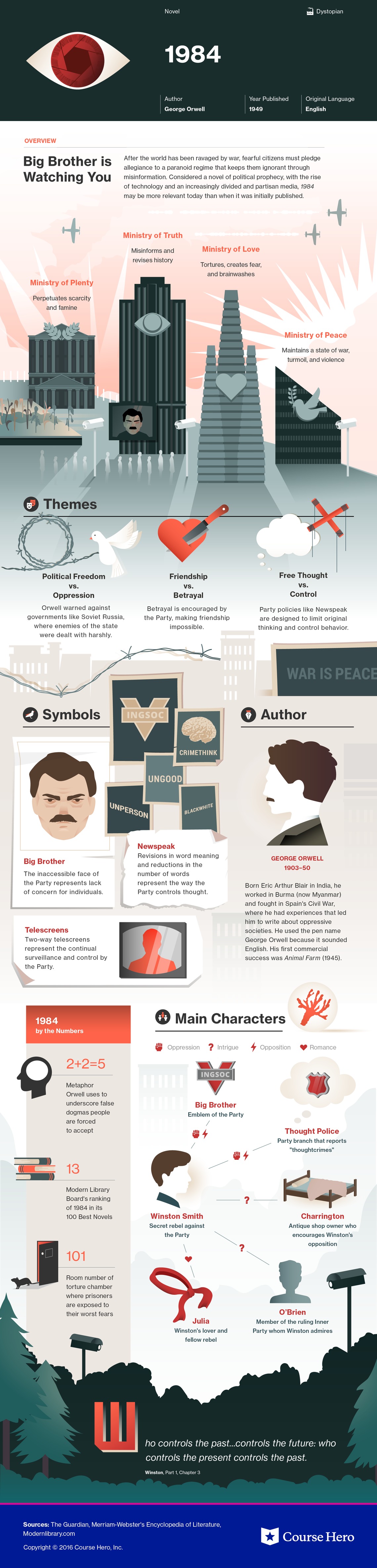
Big Brother: The infallible, semi-divine face of the Party. Whether he exists as a man is irrelevant; he exists as a focal point for love, fear, and reverence. He is the "eyes" that are always watching.
The Inner Party (2%): The "brains" of the state. They enjoy relative luxury wine, real sugar, and the terrifying ability to turn off their telescreens for short periods. They are driven by a pure, ascetic obsession with power.
The Outer Party (13%): The "hands" of the state. This is Winston’s class. They are the most heavily surveilled, as they possess the education to be dangerous but lack the power to be free.
The Proles (85%): The "dumb masses." The Party views them as natural inferiors who need only "prolefeed" (cheap entertainment, pornography, and gambling) to remain compliant. As the Party slogan goes: "Proles and animals are free."
The Four Ministries of Irony
The government operates through four ministries, named with a level of irony that defines the Party’s philosophy of deception:
The Ministry of Truth (Minitrue): Responsible for news, entertainment, and the rewriting of history.
The Ministry of Peace (Minipax): Concerned with the ongoing, peripheral war.
The Ministry of Plenty (Miniplenty): Responsible for economic affairs and maintaining a state of constant, managed shortage.
The Ministry of Love (Miniluv): The most feared ministry, windowless and surrounded by barbed wire, which maintains order through torture and brainwashing.
Tools of Control: Newspeak and Doublethink
Orwell’s most terrifying insight was that if you control language, you control thought. Newspeak is the only language in the world whose vocabulary grows smaller every year. By removing words like "freedom," "rebellion," or "equality," the Party makes the concepts behind them literally unthinkable. If there is no word for "freedom," how can one plot to achieve it?
Complementing this is Doublethink: the ability to hold two contradictory beliefs in one's mind simultaneously and accept both of them. It is the mental gymnastics required to believe that "War is Peace" or that the Ministry of Plenty is providing more food even as your chocolate ration is reduced.
Doublethink (The Death of Logic)
The psychological ability to accept two contradictory beliefs simultaneously. This is embodied in the Party's core slogans:

Part III: The Tragic Arc of Winston Smith
The narrative of 1984 is structured as a three-act descent into the abyss: The Awakening, The Rebellion, and The Annihilation.
1. The Awakening: The Diary and the Dust
The novel opens on a "cold day in April," and the clocks are "striking thirteen" the first hint that reality has been skewed. Winston Smith, a man with a varicose ulcer and a soul full of stagnant resentment, commits the ultimate crime: he buys a diary.
In Oceania, memory is the enemy. Winston’s job at the Ministry of Truth involves incinerating the past in "memory holes" to ensure that Big Brother is never wrong. By writing a diary, he attempts to anchor himself to a fixed point in time. He clings to the belief that 2 + 2 = 4 as a safeguard against the Party’s claim that truth is whatever they say it is. Writing "DOWN WITH BIG BROTHER" is his first act of self-assertion, a "suicide-in-slow-motion."
2. The Rebellion: Julia and the Golden Country
Winston’s rebellion turns from the intellectual to the physical when he meets Julia. Unlike Winston, Julia is not a political theorist; she is a sensualist. She hates the Party because it interferes with her desires.
Their affair in the "Golden Country" and later in the room above Mr. Charrington’s antique shop is a reclamation of the private sphere. They believe they have found a sanctuary. When they approach O’Brien, an Inner Party member they mistakenly believe is a rebel, they think they are joining "The Brotherhood." They are willing to do anything except stop loving each other.
The glass paperweight Winston buys during this time symbolizes their fragile world: a beautiful, useless relic of a past that the Party hasn't yet smashed.
3. The Annihilation: Room 101
The betrayal is absolute. Mr. Charrington is revealed as a member of the Thought Police, and O’Brien is revealed as Winston’s primary torturer.
The scenes in the Ministry of Love move beyond physical pain into philosophical deconstruction. O’Brien does not want to kill Winston; he wants to "cure" him. He explains that the Party seeks power for its own sake not for the "good" of the people, as previous dictatorships claimed.
"Power is in tearing human minds to pieces and putting them together again in new shapes of your own choosing."
Winston holds out until Room 101. The "worst thing in the world" differs for every individual. For Winston, it is rats. Faced with a cage of starving rats strapped to his face, the last fragment of his humanity his loyalty to Julia disintegrates. He utters the words that signify the total death of the individual: "Do it to Julia! Not me!"
Part IV: The Final Submission
The novel concludes not with a bang, but with a whimper. Winston is released back into society, a shell of a man drinking clove-flavored Victory Gin in the Chestnut Tree Café. He encounters Julia, and they both admit to their betrayal with cold indifference. The "hidden" fire in his soul has been extinguished.
He looks up at the telescreen. A victory in the war is announced. He feels a sense of blissful belonging. He gazes at the enormous face of Big Brother and realizes the enormity of his past "misunderstandings." The struggle is over. He has won the victory over himself.
He loved Big Brother.
Part V: The Legacy – Why 1984 Matters in 2026
Orwell’s work has survived because it correctly identified the vulnerabilities of the human psyche. In our current era of digital surveillance, data mining, and algorithmic echo chambers, the themes of 1984 feel less like fiction and more like a diagnostic manual.
The Erosion of Truth
Orwell showed us that a society that loses its grip on objective reality is a society on the brink of total enslavement. When "truth" becomes a matter of partisan consensus rather than empirical evidence, we enter the realm of Doublethink. In 2026, the "Two Minutes Hate" can be seen in the viral outrages of social media, and the "Telescreens" are the devices we carry in our pockets.
The Ghost of Eric Blair
By understanding Orwell’s life as the "conscience of a generation," we see that 1984 was not a prophecy of what would happen, but a warning of what could happen if we allow the language of power to replace the language of humanity.
The lesson of the novel is simple but vital: we must protect the truth, and we must protect the language we use to describe it. Because once we lose the ability to say that 2 + 2 = 4, we have lost the ability to be human. Here is the Presentation of this blog :
Reference:
Orwell, George. Nineteen Eighty-Four. Secker & Warburg, 1949. Internet Archive, archive.org/details/dli.ernet.240835.

No comments:
Post a Comment